Every minute in Costa Rica, someone calls for help. As the country’s main ambulance service provider, the Costa Rican Red Cross responds to over half a million emergencies every year. From road accidents to mountain rescues and sudden illness, they are always on the move. But until recently, the data behind these lifesaving operations was stuck in the slow lane. After a response, paramedics filled out paper incident forms which were later typed into local computers at branch offices. Information stayed siloed, hard to access, and impossible to analyse nationally. In a high-pressure environment, this limited transparency, slowed decision-making, and made it harder to learn from what was happening on the ground. That has now changed.
A National Society leading the digital change
The Costa Rican Red Cross worked with the International Federation of Red Cross and Red Crescent Societies (IFRC) and the Netherlands Red Cross’ data and digital team, 510, to map its digital landscape and identified ambulance and hospital care as a priority area for digital transformation. What started as an ambition to improve data use, has since become a functioning data management system that is changing daily work across headquarters and local branches – an important step in the National Society’s wider digital transformation journey.
Building a simple, sustainable data management system
At 510, we focus not just on technology, but on sustainability. Together with Costa Rican colleagues, the team designed a system that fits existing workflows, is easy to use, and can be maintained locally. The new data management system, built in EspoCRM, has enabled local branches to input paper forms, making data centrally available across the National Society. A digitalised version of these paper forms on ambulance tablets is currently being piloted, and anticipated to drastically accelerate data capture and analysis further.
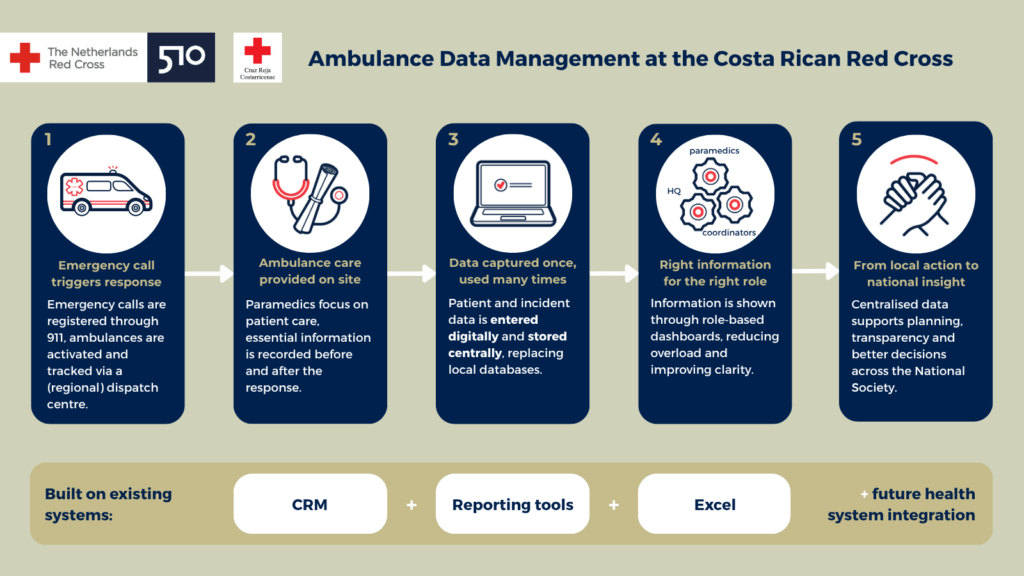
The operational impact of these changes has been transformative. A centralised system means faster insights into response times, patient needs, and resource allocation. It also means less time spent on manual entry, and more time for patient care.
Transparency, accountability and better decisions
Staff across departments report a clear increase in data transparency and accountability, creating a more accountable workflow for data entry and incident reporting.
“Before, branches stored the data locally, so headquarters didn’t have access. With the new system, we can access this information, follow up with the branches, and have a much closer incident process. It has created a closer connection between headquarters and the regions.”
Michelle Duran Cruz, Costa Rican Red Cross
Data quality has improved as well. Coordination teams now use real-time data for detailed, timely operational planning. Instead of working with incomplete or outdated information, staff can base decisions on what is happening on the ground. The system is also able to tailor dashboards to different roles. Rather than showing everyone the same forms and reports, it displays information based on what each role actually needs. This reduces confusion and information overload, ensuring that paramedics, coordinators and administrators each see the data that is relevant to their responsibilities.
Confidence, engagement and growing digital skills
The system has fundamentally changed how people feel about working with data. Staff describe increased confidence in managing data, mentioning the system’s intuitive design, training and support materials as key factors. Users now routinely export data, generate statistics and manage reports themselves, even independently organising training sessions for others.
“The system has been well received. People are genuinely interested in digitalisation, which has created a positive energy. Some people have even asked if certain features can be introduced to the system, which shows its flexibility and customisability to support their work.”
Lileana Guzman Gonzalez, Costa Rican Red Cross

Shaping the future of ambulance services
Looking ahead, centralising ambulance data will continue shaping how the Costa Rican Red Cross operates nationally. As more branches are onboarded, the organisation gains a comprehensive, countrywide picture of ambulance activity, enabling better resource allocation and strategic planning.
The Costa Rican Red Cross is currently piloting standardised information gathering in combination with the system, with ambulance tablets slowly replacing paper incident forms. Early results are positive across both high-incident urban areas and more remote regions, offering a practical setup for different operational realities.
The system’s flexibility is also opening new possibilities. Alignment with Costa Rican health data standards is being explored, with the long-term aim of integrating with national health systems. If realised, this would extend the system’s impact across the country’s wider health sector.
Why this matters for other National Societies
For National Societies wondering whether they are ready for digital systems like this, the Costa Rican Red Cross offers an encouraging example. You don’t need to be a tech powerhouse: by starting small, focusing on real operational needs, and investing in people as much as technology, meaningful change is possible. When emergencies happen, there’s no time to wait for information. With the right data in the right place, you can move faster, decide better, and deliver more effective emergency care when every minute counts.
This initiative was funded by the Ministry of Foreign Affairs of the Netherlands, based on the foundations of an earlier initiative funded by Microsoft. To further sustain the digital transformation of the Costa Rican Red Cross, another digital investment is lined up with support from Microsoft, IFRC and the Netherlands Red Cross.
تنصل: يرجى ملاحظة أن النسخ العربية والفرنسية والإسبانية من هذه المقالة تم إنشاؤها تلقائيًا باستخدام الذكاء الاصطناعي. لا يمكننا ضمان الدقة الكاملة لهذه النسخ.
نريد أن نسمع منك!
Our work in Costa Rica is part of a bigger story: from warehouse إلى feedback management, from health case tracking to ambulance coordination, 510 helps National Societies create data management systems tailored to their exact needs. Are you interested in pursuing a similar data management solution with your National Society or organization? Please reach out to:
منسق إدارة البيانات والمعلومات ويسيل دي يونغ wdejong@redcross.nl